What are the Most Common Types of Bicycle Accidents?
Daily commuters and weekend riders enjoy Florida’s scenic routes, and millions of people rely on bicycles to navigate our cities and towns. However, the inherent disparity in size and weight between a bicycle and a motor vehicle means that a collision almost invariably results in serious, life-altering injuries for the cyclist.
Statistics from the National Highway Traffic Safety Administration (NHTSA) and the Centers for Disease Control and Prevention (CDC) paint a grim picture that thousands of cyclists are injured each year, and hundreds are killed in crashes involving motor vehicles.
Unfortunately, a majority of these tragic accidents are preventable and stem from a driver’s negligence or a lapse in roadway maintenance. Understanding the types of accidents that occur most frequently is the first critical step toward prevention and, more importantly, toward building a successful personal injury claim after a crash.
By detailing the most common scenarios, we aim to equip you with the knowledge to stay safe and, if the worst happens, to protect your legal rights. At Emmanuel Sheppard & Condon, our Pensacola bicycle accident lawyer team values our clients and consistently delivers desirable results.
Schedule Your Free Case Review
Key Takeaways:
- Prioritize Your Well-being: Your immediate safety and medical attention are the most critical steps after any bicycle accident. Injuries, especially head injuries, can have delayed symptoms, so seeking a professional medical assessment, even after a seemingly minor crash, is vital.
- Safety Gear is Crucial: Wearing a helmet can significantly reduce the risk of severe head and brain injuries. Proper cycling gear, lights, and reflective materials also play a key role in visibility and accident prevention.
- Common Causes are Avoidable: The majority of bicycle accidents involving motor vehicles are often due to motorist negligence like distracted driving, failing to yield at intersections, or opening a car door into a cyclist’s path.
- Immediate Action Protects Your Rights: To secure potential legal claims, it’s essential to document the scene thoroughly, call the police to file a report, and avoid admitting fault or negotiating with the other party or their insurance company immediately.
- Know Your Legal Options: In many cases, you may be entitled to compensation for medical bills, lost wages, property damage, and pain and suffering. Consulting with an attorney specializing in bicycle accidents can help you with the legal hurdles.
Common Motor Vehicle-Involved Collisions
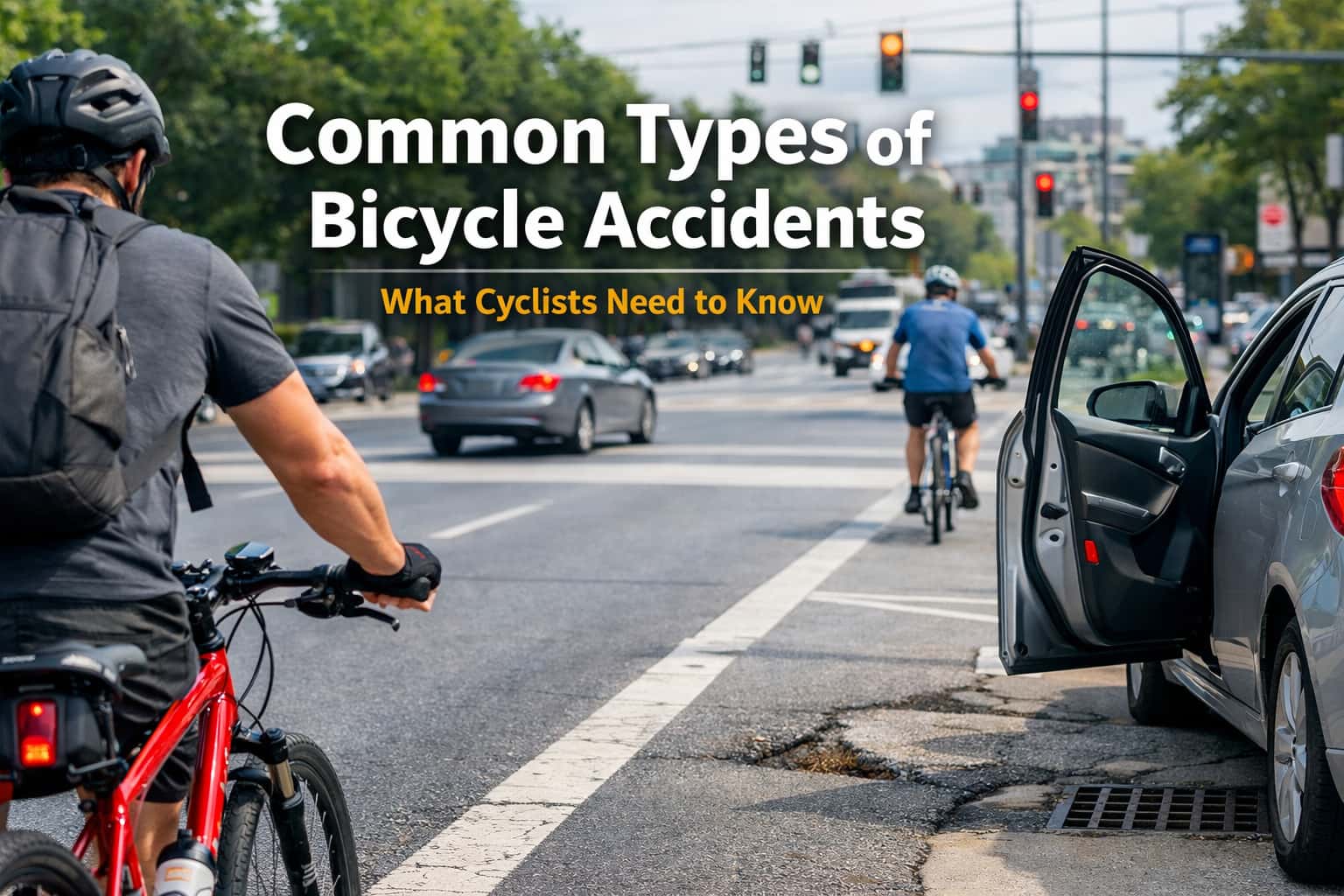
While any collision can be devastating, certain types of accidents occur with alarming regularity and are well-defined by legal and traffic safety experts. These often happen where motorists and cyclists must share space, especially near parked cars or at intersections.
The “Dooring” Accident: A Sudden Hazard
A “dooring” accident occurs when a driver or passenger of a parked vehicle suddenly and carelessly opens their door directly into the path of an oncoming cyclist. This scenario is particularly prevalent in urban areas with parallel parking and designated bike lanes.
- How it Happens: A cyclist is traveling legally down the street, often in a designated bike lane, when a vehicle occupant opens their door without checking the side mirror or looking over their shoulder. The cyclist has no time to react and crashes directly into the door or is thrown violently into the adjacent traffic lane, risking a second, more severe collision with a moving vehicle.
- Legal Focus: Liability almost always falls on the individual who opened the car door. Many jurisdictions have laws specifically prohibiting the opening of a car door until it is reasonably safe to do so. Proving this negligence typically involves demonstrating the cyclist was traveling lawfully and that the door was opened without warning.
The “Right Hook” and “Left Cross”: Intersection Dangers
Intersections are some of the most hazardous places for cyclists. Confusion over right-of-way, driver inattention, and aggressive turning maneuvers lead to two of the most frequent and dangerous types of collisions: the “Right Hook” and the “Left Cross.”
The Right Hook Accident
- How it Happens: A motorist and a cyclist are traveling in the same direction. The motorist intends to make a right turn, but instead of merging or slowing to accommodate the cyclist who is going straight, the driver cuts sharply in front of the bike and hits them, or forces the cyclist off the road. This can happen when a driver passes the cyclist and immediately turns right, or when a driver does not see the cyclist approaching on their right-hand side.
- Legal Focus: In Florida, when a cyclist is proceeding straight, they have the right-of-way over a turning vehicle. The driver is negligent for failing to yield and for making an unsafe turning maneuver.
The Left Cross (or “Left Hook”) Accident
- How it Happens: A motorist is traveling in the opposite direction of the cyclist and is attempting to make a left turn across the cyclist’s path. The driver misjudges the cyclist’s speed or distance, or simply doesn’t see them, and turns directly into them.
- Legal Focus: A driver turning left must yield the right-of-way to oncoming traffic, including bicycles, which are legally considered vehicles on the road. The driver’s failure to properly observe the road and yield constitutes negligence.
Rear-End Collisions: Failing to Share the Lane
While a rear-end collision might seem less likely for a cyclist, it is a tragically common occurrence, especially on roads without dedicated bike lanes where cyclists are forced to take the lane.
- How it Happens: A driver approaches a cyclist from behind and, due to distracted driving (like texting), speeding, or following too closely, fails to notice the cyclist in time to slow down or pass safely. The force of a rear-end collision, even at moderate speeds, can be catastrophic for the unprotected rider. This also frequently occurs at stop signs or traffic lights when a driver is distracted and rolls into the back of a stopped cyclist.
- Legal Focus: Drivers are obligated to maintain a safe following distance and to operate their vehicle with due care. In almost all rear-end accidents, the trailing driver is presumed to be at fault unless the cyclist violated a specific traffic law in a manner that directly caused the collision.
Accidents Not Involving Other Vehicles
It’s a misconception that all bicycle accidents involve a car. A significant percentage of serious injuries and even fatalities result from falls or collisions with fixed objects due to unsafe road conditions. When these accidents occur, the negligence of a third party, such as a government entity, may be the root cause.
Accidents Caused by Dangerous Road Conditions
A minor pothole or crack that a car’s suspension barely registers can be a life-threatening hazard for a cyclist.
- Causes:
- Potholes, cracks, and uneven pavement that cause the rider to lose control and fall.
- Loose gravel, sand, or construction debris left in the road or bike lane.
- Poorly designed or maintained storm drains with grates that can trap a bicycle tire.
- Faded or confusing lane markings that lead a cyclist into a dangerous position.
- Legal Focus: In these cases, liability may fall upon the government body (city, county, or state) responsible for the road’s design and maintenance. Suing a government entity, however, involves complex legal processes and short deadlines known as Sovereign Immunity that are very different from filing a claim against a private individual. This makes immediate legal consultation essential.
Schedule Your Free Case Review
Critical Factors Contributing to Bicycle Accidents
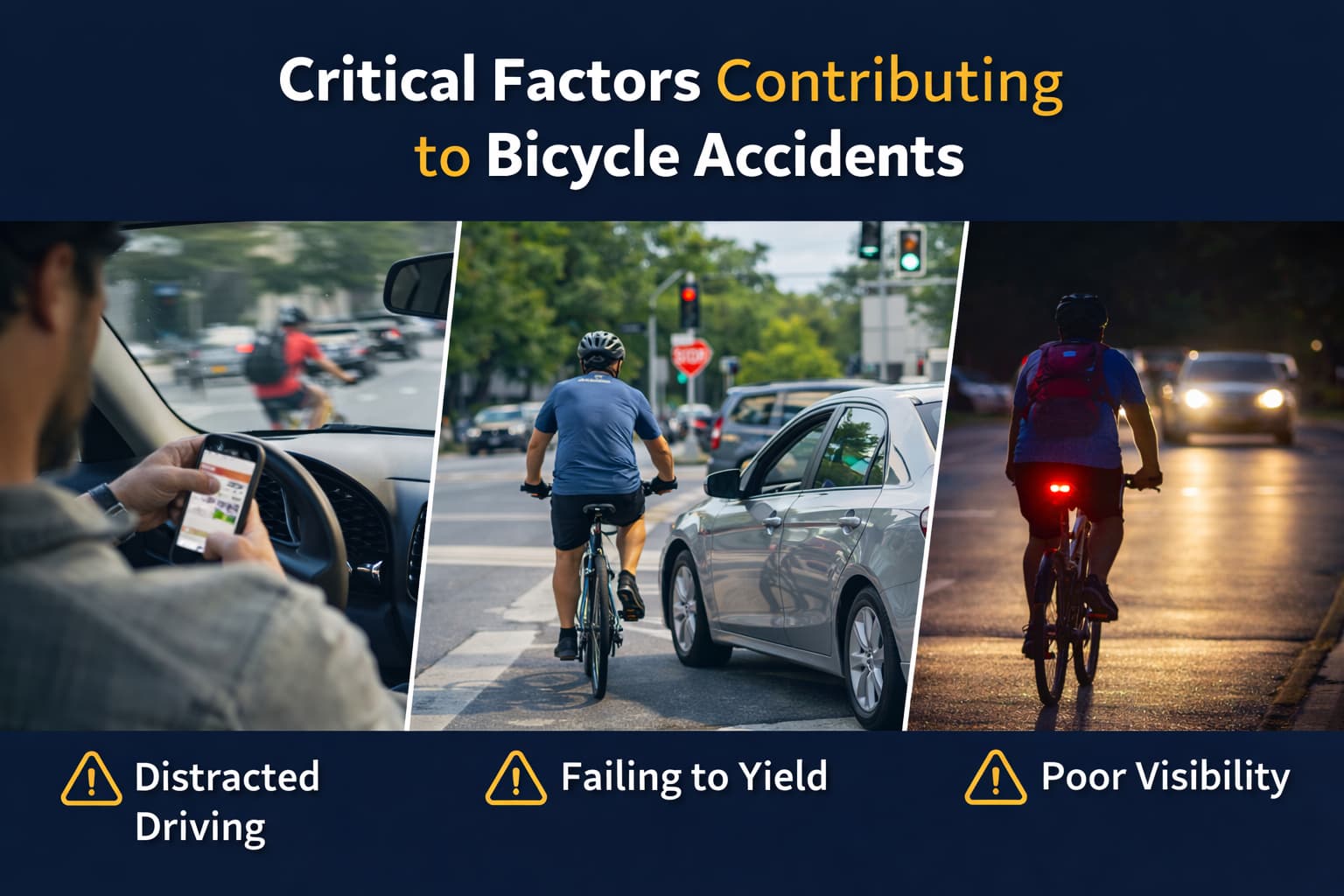
While the accident type describes the event, the underlying causes often point directly to negligence, which is the cornerstone of any personal injury claim.
Distracted Driving and Driver Negligence
Distracted driving is the leading cause of motor vehicle accidents nationwide, and cyclists are disproportionately affected. A distracted driver may not see a cyclist until it’s too late. The law requires motorists to operate their vehicles with “reasonable care” and “due regard” for all other people on the road, including cyclists. A breach of this duty, which results in a collision, is negligence.
Failing to Yield the Right-of-Way
Many accidents at intersections, including the “Left Cross” and “Right Hook,” happen because a driver failed to yield. Motorists are often unaware or disregard the fact that bicycles have the same rights and responsibilities as cars on the road. Traffic laws dictate who has the right-of-way, and when a driver violates that law, they are typically liable for the resulting crash.
Poor Visibility, Lighting, and Night Riding
A higher percentage of fatal bicycle accidents occur at night, and poor visibility is a significant factor. While cyclists are legally obligated to use lights and reflectors, drivers must also exercise extra caution in low-light conditions.
- Driver Negligence: A driver who is tired, impaired, or simply speeding in the dark may not see a legally lit cyclist until it is impossible to stop.
- Cyclist Negligence: A cyclist who fails to use mandated front and rear lights or wear reflective gear may be found partially at fault for an accident, which can complicate their claim under comparative negligence laws.
The Devastating Injuries That Result
Due to the lack of physical protection and the high impact forces involved, bicycle accidents frequently result in catastrophic injuries that require extensive medical care and long-term rehabilitation. The most common and severe injuries include:
- Traumatic Brain Injuries (TBI): Even with a helmet, concussions, skull fractures, and severe TBIs are common. These injuries can lead to lifelong cognitive and functional impairments.
- Spinal Cord Injuries: Falls and impacts can cause fractured vertebrae, herniated discs, or full spinal cord trauma, potentially resulting in partial or total paralysis.
- Fractured Bones: Broken arms, wrists, hands (from attempting to break a fall), collarbones, ribs, and legs are standard in bicycle-car collisions.
- Road Rash and Severe Lacerations: The scraping of skin against the asphalt causes deep abrasions that can require intensive medical treatment, skin grafts, and leave permanent scarring.
- Internal Organ Damage: The sheer force of impact can cause internal bleeding and damage to the lungs, spleen, or kidneys, which may not be immediately apparent.
These devastating injuries underscore the necessity of securing maximum compensation to cover current and future medical bills, lost wages, and the pain and suffering endured.
The Legal Ramifications: Establishing Fault and Seeking Justice
The nuances of a bicycle accident claim go far beyond the initial police report. A successful personal injury case requires establishing the negligence of the at-fault party—be it a driver, a government agency, or other individual—and meticulously documenting all damages.
Understanding Comparative Negligence
In personal injury law, the concept of Comparative Negligence is vital in bicycle accident cases. This principle recognizes that sometimes both parties may share some degree of fault for an accident.
- For example, a driver may have cut off a cyclist (70% at fault), but the cyclist may have been riding without required lights at dusk (30% at fault).
- In states that follow a comparative negligence rule, your total compensation is reduced by your percentage of fault. If your damages were $100,000 but you were found 30% at fault, your recovery would be reduced to $70,000.
- Florida follows a modified comparative negligence rule which means that you cannot recover any damages if you are found to be 51% or more at fault for the accident.
Insurance companies will aggressively try to shift as much blame as possible onto the cyclist to minimize their payout. This is why having an experienced bicycle accident attorney is crucial to effectively counter these tactics and protect your right to compensation.
Liability Beyond the Driver: Government
As discussed, liability is not always limited to the motorist. An attorney will investigate governmental liability if the accident was caused by a dangerous road condition, like an unaddressed sinkhole, poor signage, or a malfunctioning traffic light, a claim may be filed against the responsible governmental agency.
Protecting Your Rights After a Bicycle Accident
Bicycle accidents can change your life in an instant, leaving you with severe injuries, mounting medical debt, and the inability to work. When you are hit by a car, injured by a dangerous roadway, or involved in a crash due to road conditions, you are in a fight against powerful insurance companies and potentially even the government.
You should not have to face these legal and financial challenges alone. At Emmanuel Sheppard & Condon, our Pensacola personal injury lawyer team is dedicated to advocating for the rights of injured cyclists. We understand the specific traffic laws, the tactics insurance companies use to minimize claims, and the medical documentation required to prove the extent of your injuries and needs.
Our goal is to handle the legal hardships so you can focus entirely on your recovery. If you or a loved one has been injured in a bicycle accident, the clock is already ticking on the Statute of Limitations—the strict deadline for filing a claim.
Don’t wait to seek legal counsel, call us at (850)433-6581 today.
Schedule Your Free Case Review